Monday, July 30, 2012

Beasts of the Southern Wild (2012)


Beasts of the Southern Wild (2012), directed by Benh Zeitlin, 4.5 stars

“When you're small you’ve got to fix what you can” – Hushpuppy

Fox Searchlight has a real winner in “Beasts of the Southern Wild.”  The film features a stirring performance by six-year old Quvenzhané Wallis, who plays Hushpuppy, a young girl living with her sickly but stern and stubborn father (Dwight Henry) in the unforgiving marshland somewhere in bayou country on the outskirts of New Orleans.  The story of the impact and aftermath of a fierce tropical storm on a small community dubbed the “Bathtub,” is told from her point of view.  It is also a story of coping with overwhelming loss.  The area has been ravaged.  Nearly all of the homes are either completely submerged or damaged beyond repair.  Those few who have opted not to leave prior to the deluge begin defiantly rebuilding their lives, but then the government intercedes, condemning homes and forcibly evacuating the remaining residents.  Hushpuppy’s world is in upheaval.  Her teacher has warned her and her classmates of the perils of global warming, and the young girl envisions ancient aurochs (forerunners of modern cattle, but depicted in the film as fierce, oversized boars) stampeding into the modern world after being released from a cryogenic state by melting polar icecaps.

Nature plays a palpable part in the film. One can almost smell the stench of rotting animal carcasses, feel the heavy pull of mud under foot, taste the juices flowing from freshly-fished steamed crabs and crawdads. The community depends almost entirely for its livelihood on the whim of natural forces, so it follows that the a close relationship to the environment permeates the entirety of their lives.  Hushpuppy, a precocious, highly-intuitive philosopher, sums it up best. “The whole universe depends on everything fitting together just right.  If one piece busts, even the smallest piece, the entire universe will get busted.”  Her community takes every opportunity to celebrate because it will never acquiesce to the overwhelming force of nature and its cycle of life and death.  As Hushpuppy proudly asserts early on in the film, “the Bathtub has more holidays than the whole rest of the world.”

Although filmed in areas in and within a few hours drive from New Orleans, the movie feels more like the product of a foreign-born director than of a 30-year old from Queens.  In his first feature-length film, Benh Zeitlin has brilliantly captured a world that is alien, out-of-balance (hence, perhaps, the entirely hand-held camerawork), and yet immediately accessible to an audience.  He offers us a glimpse into the heart and soul of humanity everywhere through the eyes of young girl whose observations on survival play out in the most appalling of primitive conditions.  The film has already won several Cannes Film Festival awards as well as the Grand Jury Prize at Sundance.  I believe that the film is also destined for similar honors at the next Academy Award celebration.

Wednesday, July 25, 2012

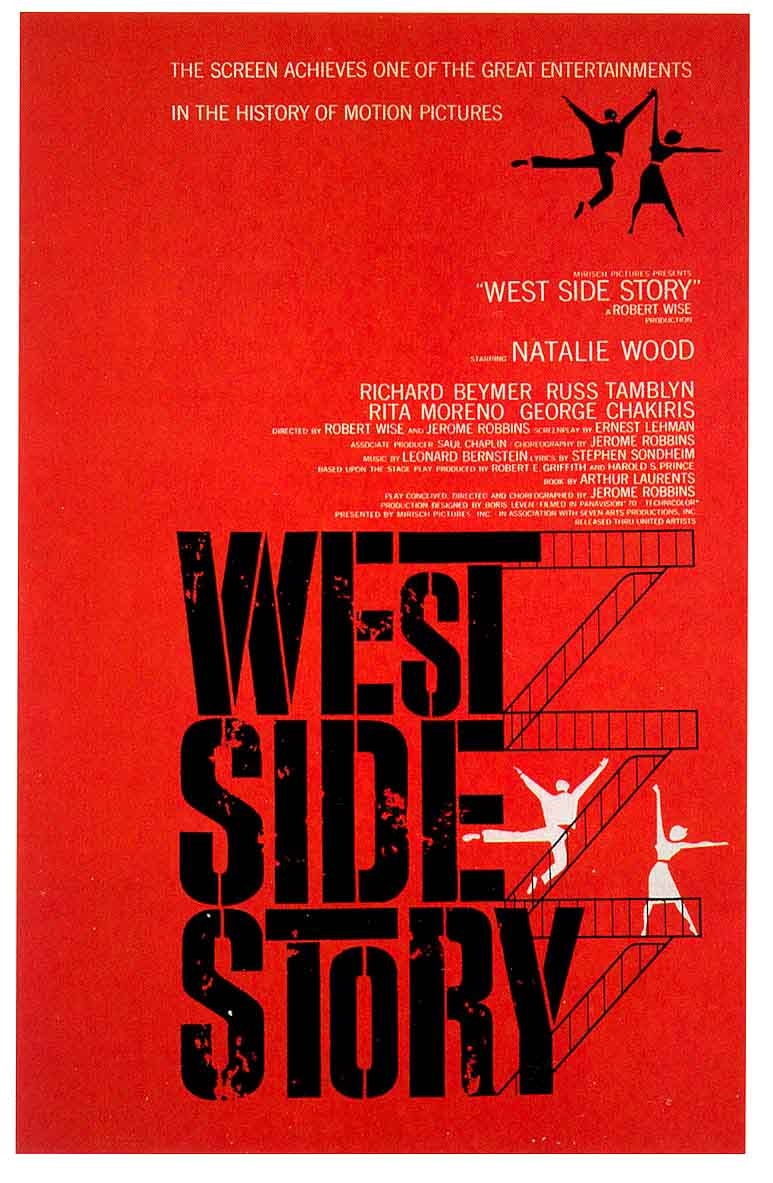
“West Side Story” (1961)


“West Side Story” (1961) – directed by Robert Wise and Jerome Robbins (5 stars)

“Life is all right in America if you’re all white in America” 

Evelyn (my wife) and I had already sat through one film at the theater on the day we saw “West Side Story.” We happened to meet up with the projectionist on our way out of the earlier film, and he happened to be discussing with another audience member just how stellar the 70mm print of this film was going to look on the big screen.  So, I asked Evelyn if she was willing to stay to watch the opening sequence, which features an incredibly energetic dance sequence filmed on location in Manhattan.  She begrudgingly agreed, and it was just as good if not better than I remembered it.  When it ended, I got up to leave and was summarily ordered to sit down.  We sat through the entire film, intermission and all.  Such is the power of cinema at its best.  Say what you will about the dated aspects of the dialogue and the weak acting of the two leads, the film is still an absolute pleasure to watch.  Seeing it in 70mm with a large, engaged audience enriched the experience far beyond what would have been possible on my home TV, no matter how large a group I might be able to assemble or how large my screen.  

The musical recounts the familiar story of star-crossed lovers, whose relationship is doomed from the moment they meet.  Like Shakespeare’s “Romeo and Juliet,” upon which this story is closely based, Maria (Natalie Wood), an immigrant Puerto Rican, and Tony (Richard Beymer), a native born white of Polish ancestry, begin their brief affair just as their clannish kinsmen are preparing to rumble.  Tony’s best friend is Riff (Russ Tamblyn), the leader of a white gang dubbed the Jets.  Maria’s brother is Bernardo (George Chakiris), the leader of the Puerto Rican gang the Sharks.  Could the deck be stacked any higher against them?  Young, innocent and oblivious, ultimately, they very quickly fall victim to the culture of honor that surrounds them.  Territoriality, racism, misogyny, misunderstandings, and sheer bad luck conspire to dash any chances they may have had for happiness.

 
“West Side Story” was nominated for 11 and won 10 Academy Awards, including Best Picture, Director (Robert Wise and Jerome Robbins), Supporting Actors (Rita Morena and George Chakiris), Art Direction, Cinematography, and Editing.  However, two key contributors did not win and were not even nominated.  These were composer Leonard Bernstein and lyricist Steven Sondheim, without whose contributions this film could never have been made. (Ironically, the four men who arranged the score shared the Award for Music.)  Bernstein’s hallmark fusion of syncopated jazz and Latin rhythms mirrored the out-of-balance lives lived by the protagonists and their peers.  Sondheim lyrics are brilliant and incredibly on the mark, whether applied in a romantic (“Somewhere”), sarcastic (“America”), or socially satirical (“Gee, Officer Krupke”) setting.  And then there’s the film’s spectacular opening dance number.  Following a series of aerial shots of Manhattan, the choreography escalates from cat and mouse games between small units of the Jets and Sharks into increasingly larger and more violent encounters.  The creative energy required to put together this lengthy sequence must have been enormous.  There is so much going on that it’s not possible to take in all of the action playing out on the large, wide screen.

With the exception of “Saving Private Ryan,” I can think of no other film that sustains from its opening shot so long a high level of energy.  What does it matter if the two leads are dubbed and John Astin (“Addams Family”) is miscast as the chaperon at the dance or if Simon Oakland (Lt. Schrank) recites his line as blandly as if he’s explaining why Norman Bates killed his mother in “Psycho” (which he did)?  The story, the songs, and the dancing just don’t get any better than this.  No wonder it’s rated number 51 on AFI’s top 100 list of American films and number 2 (just below “Singing in the Rain”) on their top 100 list of musicals.  And no wonder, too, that Evelyn (and I) decided to watch it once again, this time in all its 70mm glory.

Monday, July 23, 2012

Ju-on: The Grudge (2002)


Ju-on: The Grudge (2002), directed by Takashi Shimizu, 4.5 stars

"A Curse born of a strong grudge held by someone who died.  The place of his death gathers his grudge.  Anyone who comes into contact with this curse shall lose his life and a new curse is born."  – Japanese proverb

If “Ju-on: The Grudge” is any indication, haunted houses in Japan don’t play by the same rules as those invented in Hollywood.  It doesn’t matter if you’ve been bad or good; you’re as good as dead when you enter the one in this film.

This is the only film in the “Ju-on” oeuvre that I’ve seen so far, and on first viewing (I’ve since watched it again), I found it eerily unsettling.  I also found it a bit confusing, but not as a result of any deficiency in the film.  I simply couldn’t consistently differentiate all of the characters.  There are many of them, and some not only look similar (at least to me), they also have similar sounding names.  On second viewing, this was not a problem, and I’m sure it would not be a problem of any sort for a Japanese audience. 

The film is organized into 10-15 minute titled segments that move backward and forward in time, a narrative form that makes the film much more interesting and demands more attention from the viewer.  I’m still not 100% clear if any of these chapters actually represents the present, but for my own purposes, I will ascribe that timeframe to the first full segment titled “Rika.” The scene begins after the credits and a violent opening sequence consisting of quick and jarring cuts to blades, blood, and other carnage, none of which can be fully contextualized until one has seen the film in its entirety.  If “Rika” takes place in the present, then we travel both into the past as well as several years into the future, but I’ll say more about that a bit later.

Rika, a young and inexperienced social worker, is sent to pay a visit to an elderly woman.  A colleague was dispatched the day before and has not been heard from.  Rika enters the house and finds it littered with food and miscellaneous debris which is strewn all about.  She hears scratching coming from a translucent screen door and opens it to find the old woman clawing at it, the first in a series of progressively spookier scares.  After cleaning up as best she can, she hears a noise and follows the sound to an upstairs bedroom where she finds a closet that has been carelessly taped shut.  A cat howls from behind the closet door, so she removes the tape, peers inside, and spots the cat and a little boy, bruised from head to toe, holding on to it.  I don’t think I’m giving too much away by saying that the boy and cat are bad news, but they’ve got nothing on the other dangerous denizens of the house.  Not that it makes much difference.  All of them are equally capable of dispensing a momentary chill of terror prior to dispatching their victim.

But it isn’t the blood and gore that makes this film so effective.  It is the steady stream of small horrors that nibble at the psyche before consuming their victims whole.  Objects of terror are as likely to appear in a bright, busy restaurant as they are in the recesses of a dark attic.  They are especially likely to lurk in one’s peripheral vision.  A turn of the head and they’re gone—at least for now.  Characters are never really sure if there was or still is something there, and often neither are we.  


Director Takashi Shimizu is a master of transference.  The audience is nearly as unnerved as Rika and others by the subtle assaults on our consciousness: a floating wisp of hair, a puff of black smoke, a distorted image on a TV screen, a small figure rushing by out of the corner of one’s eye, a figure reflected briefly in a glass door, or a mirror that momentarily reveals a ghostly shadow.   These images linger long, and like the demonic curse they represent, are not confined to the threshold of a hateful, haunted house.

Saturday, July 21, 2012

Riffraff (1936)


Riffraff (1936), directed by J. Walter Ruben, 3 stars

"What's past is gone out and over and done with" – Nick Lewis


The above quote nicely sums up the recurring motif of this film, that is, that pretty much all sins are forgivable--provided one makes an earnest attempt to atone for them.  And sins aplenty occur during this emotionally-wrought tale of tuna workers exploited by their oily factory boss, Nick Lewis (Joseph Calleia).  One surmises that he must have changed his name since he speaks in a contrived form of pidgin English, no doubt intended by the screenwriters to inject humorous malaprops aplenty into the dialogue.  Nick is smitten by Hattie (Jean Harlow), and who wouldn't be?  She’s drop-dead gorgeous and alternatively sweet and sassy in inimitable Harlow style.  Hattie, on the other hand, is in love with “Dutch” Muller (Spencer Tracy), an egomaniacal tuna fisherman who works in Nick's factory.  However, Nick is so self-absorbed that he ignores her overtures. Instead, he occupies his time making reckless decisions that wind up wreaking increasing havoc not only on Hattie and his closest friends, but on the entire community dependent on the fishery for its livelihood.

But no matter how poorly perspicacious Dutch's decisions turn out to be, the movie makes a point of differentiating them from the ever-present 30s red menace that seeks to use Nicks’ exploitative business practices as an excuse for a socialist solution.  Communists are portrayed as either bat-wielding thugs or as arrogant highbrows who use the biggest words available when fewer syllables would carry the day.

The attraction that Dutch and Hattie display off and on for one another transcends the political environment that surrounds them in a way that could only work in a Hollywood film.  Initially, Dutch wants nothing to do with his fellow fishermen, who are on the verge of calling a strike that will most certainly lead to their being replaced by scabs.  He'd rather spend his time in a local tavern in the company of two lovely ladies.  But it takes only the slightest stroking of his ego by Hattie and others to nudge him into action: the delivery of a speech that leads to a huge brawl outside the cannery.  Despite the fact that Dutch and Hattie were at each other’s throats only moments before, she chooses to help him escape from the police by creating a distraction, wrapping a can of tuna in paper, flinging it into the melee, and crying “bomb.”  When she later congratulates him for averting the strike, he reacts violently, pushing her to the ground.  Hattie gets her revenge in short order by hurling a fish at him while reporters are filming an interview.  It hits him in the face, causing him to loses his balance and fall overboard into the water—all this while the cameras are rolling.  This row doesn't prevent them from marrying, becoming pregnant, having irreconcilable differences, and then divorcing, all in short order.  The attraction between the two lies in their studio star power, not in themselves and certainly not in their stars.

“Riffraff” was the second film Harlow made with Spencer Tracy in 1936, the other being the better known and better film, “Libeled Lady.”  Although sparks fly in this film, the sparkle just isn’t the same between the two as it is with Harlow and her other leading men.  I'm thinking especially of Clark Gable.  But other cast members do liven things up quite a bit.  Una Merkel as Lil, Hattie's sister, and Mickey Rooney as Jimmy, Lil's son provide plenty of fast-talking wisecracks as well as real help when it's needed.  Anita Loos, Frances Marion, and H.W. Hamemann were responsible for the snappy screenplay, which is filled with zingers, though the highlight for me are the conversations in broken English between Nick and Markis (George Givot), his lawyer, which I found simply hilarious.  This is neither Harlow’s or Tracy’s best effort by far, but it is an interesting if not a totally successful pairing of two of MGM’s big box-office sensations.

Tuesday, July 17, 2012

Mimic 3 Sentinel (2003)


Mimic 3 Sentinel (2003), directed by J.T. Petty, 1 star

"Haven’t you guys seen this movie?" – Marvin Montrose

If the demonstrative pronoun in the above quote referred to “Mimic 3 Sentinel,” then my guess is that few people would answer yes to the question posed.  And that’s a mercy.  In the film, however, Marvin Montrose (Karl Geary), a sickly bubble boy confined largely to his room, is referencing Alfred Hitchcock’s “Rear Window” even though he does not name the film.  The question is posed to his hopelessly drug-addicted younger sister Rosy (Alexis Dziena) and her friend Carmen (Rebecca Mader), a pretty young lady from across the alley.  Since his question is never answered, one can infer that neither of these characters know what he’s talking about, but my having seen both films, I wonder what director/screenwriter J.T. Petty is talking about.  Yes, both films do feature a man with a camera who is confined for medical reasons to his room, but “Rear Window” is a masterful piece of filmmaking and “Mimic 3 Sentinel” is a miserable piece of something entirely different.

In his pre-digital world, Marvin unabashedly takes picture after picture from his bedroom window, most of which are terrible.  It must have cost his family a fortune to develop all the photographs that he's plastered on the walls of his room.  He shoots with the lights on so everyone in the neighboring apartments can see what he’s doing, but nobody seems to notice or care.  His timing is also invariably way off.  When there is nothing going on, his eye is glued to the viewfinder.  When creatures come in for the kill, he’s nowhere to be found.

I’d really like to say something nice about the film, but I just can't think of anything.  The cast does include Amanda Plummer (“Pulp Fiction”) as Marvin’s mom and Lance Henriksen (“Aliens”) as “the garbage man” (don’t ask), but neither actor is given any motivation or material to work with.  When they die (oh, sorry; I guess that was a spoiler), it’s good riddance to bad rubbish.

There’s nothing going on in the way of filmmaking either.  The plot is plodding; the score is uninspired (what’s with the unseen, diegetic viola?); and all of the characters—not just Marvin—seem completely enervated and sleep-deprived.  Perhaps, the actors who portrayed them really were.  The film was shot in Romania (most of the crew have diacritical marks in their names and there’s also a nod to Bucharest in the end titles), and except, perhaps, for the effects shots, it couldn’t have taken very long to shoot the whole thing.  Maybe the crew rushed through it as quickly as possible to put it all behind them.  Sheer speculation on my part, I admit.

So why did I watch it through to the end?  For the same reasons I always do.  I obsess over completion: After watching “Mimic,” I stumbled upon the two sequels, and that as they say is that.  In my estimation, this is the worst of the bunch by far.  If you like films about angry overgrown bugs, there are many others to choose from, any one of which has got to have more going for it than this.

Sunday, July 15, 2012

“Mimic 2” (1997)

“Mimic 2” (1997), Jean de Segonvac, 1.5 stars

“What the hell are we looking for?” – soldier

With all of the headaches the original “Mimic” created for its director and, presumably, its producers as well, you wouldn’t expect anyone to pony up any more money on a sequel but, nevertheless, that’s just what happened.  Screenwriter Joel Soisson (“Bill and Ted’s Excellent Adventure”) takes Remy (Alix Koromzay), the most minor of the major characters in the original film, gives her a backstory as a science teacher, and concocts a horrific scenario that provides her with her own heroic journey.  In the first film, Remy assists Dr. Susan Tyler of the CDC in an ill-defined capacity while her boss descends deeper and deeper into the innermost rings of hell.  Here, the hellishness plays itself out in a deteriorating public school somewhere in the South Bronx.  People are losing face (literally) and one of these poor unfortunates is a dunderhead Remy recently dated and now wants nothing to do with.  She sure knows how to pick 'em.  Her wall is plastered with Polaroids of herself in the aftermath of countless dates gone wrong.

But we don’t really care.  Remy’s not a particularly attractive or sympathetic character herself, and the sad truth is neither is anyone else who winds up in harm’s way.  Certainly not Detective Klaski (Bruno Campos), who noses around trying to get to the root of the ghastly homicides.  He’s pretty much clueless, and hopelessly crass to boot.  Nor do we worry whether or not the young’uns, Nicky (Will Estes) and Sal (Gaven E. Lucas), will survive their after-hours ordeal in the bowels of the school.  The former is too hormonally out of balance, and the latter, although he's a cute kid, doesn’t really say or do anything worthy of surviving through to the end credits.  In fact, he does some pretty stupid things along the way.

Although the plot is anything but, the film itself looks very smart.  Like its predecessor, much of the action takes place in darkness illuminated by a stray light here and there, which may or may not flicker annoyingly for additional effect.  The production also oozes more than its fair share of luminescent slime, and bugs of all sizes crash through ceilings and walls right on their frenetic musical cues.  Director Jean de Segonzac (“Homicide: Life on the Street”) distorts the camera and places it at all sorts of odd angles, but this is an example of excessive form attempting to compensate for inadequate content.  Though I like the original film quite a bit, I’m afraid I can’t recommend its offspring.  Gone are all of Guillermo del Toro's signature themes:  faith, dispair, heroism. The bugs are back, but no one is any smarter or renewed spiritually as a result of surviving an encounter with them.  And from everything I’ve read, which admittedly isn't much, I can’t imagine that the next genetic mutation in the series (“Mimic 3 Sentinel”) will be much better: a conclusion I will at some point in the near future no doubtedly wind up drawing for myself.

The Unholy Three (1930)


The Unholy Three (1930), directed by Jack Conway, 3.5 stars

“That’s all there is to life – just a little laugh, a little tear.” – Professor Echo

Lon Chaney was late getting into sound pictures.  He made only one, a remake of his 1925 hit, “The Unholy Three,” and it was to be his last film. Just over a month after its release, he died from bronchial, throat, or lung cancer, depending on which of the many online biographies you read.  One of the reasons he may have chosen this to be his first foray into sound was because it not only featured the actor in disguise, it also gave him the opportunity to show off his ability to create several distinct voices, giving rise to the film’s ad campaign, which touted with typical Hollywood hyperbole, “The Man of a Thousand Faces is now the Man of a Thousand Voices!”

The plot of the film is nearly identical to its silent forbear, though economically pared down from 86 to 72 minutes.  I’ve seen many argue that the original, directed frequent Chaney collaborator Tod Browning is the superior of the two films, and at first glance, the remake creates very little that is new or different if you subtract the vocal track.  However, it is exactly because of the now precious on-screen presence of Chaney’s commanding voice(s) that this film is worthy of note, and because it is, it’s equally interesting to take a look at some of the changes that were made and to speculate as to why they were.

First, there are two new very brief comedic bits that take place at the start of the film during Professor Echo’s (Chaney) ventriloquist act.  His dummy offers to sing a song a song titled “She Was a Butterfly’s Daughter,” which opens with the title line followed by “But he was a son of a bee.”  Echo immediately covers the dummy’s mouth and admonishes him to behave.  A few moments later, he projects a female voice into the audience which causes a sailor to put the moves on a young lady standing beside him.  Many Hollywood films of the early 1930s pushed conservatives Americans to the limit, resulting in a significant clamping down by censors in the summer of 1934.

The next difference is in the introductions of the various characters.  The gorilla, who plays a key role late in the film, is brought in much earlier, and the antipathy between the animal and Hercules (Ivan Linow), makes much more sense after we see the strong man antagonize the ape with a slingshot.  Echo’s warning to Hercules goes unheeded:  “You’re gonna do that once too often and he’ll tear you to pieces.”  An even smaller difference, but a curious one, occurs during the first interaction between Echo and Rosie O'Grady (Lila Lee).  In the silent version, Echo offers her a steak dinner for being such a good pickpocket.  In this film, he offers her steak with mushrooms, and it’s the mushrooms (not the steak, as in the original) that impel her to reveal the rest of her stash to him.  I wonder if this is a depression-era update denoting, perhaps, one particular frill that is no longer available (or affordable) to the working class.  Getting back to character intros, there’s one change worth noting.  Like Hercules, Tweedledee, the midget (Harry Earles) is clearly a much darker character in the sound film.  The last of the unholy three to be introduced, when the barker (Richard Carle) alerts him that it’s nearly time for him to do his act and they’ve got a good crowd of nice people, Tweedledee goes into a bitter rant, which ends with “I’d like to poison them all.”  This better sets up the following scene in which he responds to a young boy’s taunts by kicking him in the face.

Fred Kelsey and Lon Chaney
Perhaps, the biggest difference is in the endings of the two films.  In the original, Echo confesses and is forgiven for his crimes.  He releases Rosie from her promise to remain with him and returns with his manikin to the carnival.  In the remake, Echo in the guise of Grandma O’Grady is unmasked in the witness stand by the District Attorney (John Miljean) and receives a one-to-five year prison sentence.  Once again, he frees Rosie to find happiness in the arms of another man, but this time, with the lovers united and the train pulling out of the station on its way to the penitentiary, Echo calls out his final words from the observation car: “I’ll send you a postal card.”  As the screen fades to black, Chaney waves one last time to the screen.  Exit way too soon one of the greatest, multi-talented entertainers ever to grace the movie screen.